[Case 02]
Reimagining how undergraduate students discover library workshops
Higher Education - Service Design

[Project Overview]
University of Miami Libraries offers workshops, but many undergraduate students are unaware they exist, struggle to find them, or don't see the programming as designed for them.
Our team partnered with University of Miami Libraries to explore how its workshops could better reach undergraduate students. Through stakeholder research and student observation, we identified barriers around awareness, discoverability, and relevance, then explored and prototyped new approaches to undergraduate outreach.
Methods
Stakeholder Interviews
User Observation
Crazy 8s
Concept Testing
Role
Research
Synthesis
Ideation
Projection Organization
Team
4 Students
Collaborative Project
Duration
2 Months
Deliverables
Outreach Concepts
Promotional Prototype
Survey Prototype
Strategic Recommendations
[01] Frame
We started with an awareness problem.
Our team began with a broad challenge: the University of Miami Libraries wanted to better reach undergraduate students with its workshops. Before jumping into solutions, we met with a librarian to understand how workshops were currently designed, promoted, and used.
What we heard from the stakeholder

What we found
01 · Graduate-focused programming
Existing workshops were primarily designed around graduate students, creating a need for programming that felt more relevant to undergraduates.
02 · Limited undergraduate outreach
The library identified marketing and outreach as a major challenge and wanted better ways to reach undergraduate students.
03 · A need for better targeting
The library wanted to understand what workshops undergraduates actually needed and how programming could better serve specific student groups.
Next Question:
What does the workshop experience look like from the student’s perspective?
[03] Reframe
The problem was bigger than awareness.
Bringing the stakeholder interview and student observations together changed how we understood the challenge. Increasing promotion could help students learn that workshops exist, but it would not address whether students could easily find them, understand their value, or see them as relevant to their needs.
Mapping the system behind the problem
Our observations showed that low engagement wasn't caused by a single barrier. We mapped the broader system around library workshops to understand how awareness, access, relevance, format, attention, and feedback interacted with the people and processes surrounding the program.

What the system map reveled
Multiple barriers to
engagement
Awareness was only one constraint. Access, relevance, format, attention, and feedback also influenced whether students engaged.
Discovery depended on a
larger network
Professors, campus resources, student organizations, and peers could all influence whether students discovered and trusted workshops.
The system lacked a
feedback loop
Without consistent student feedback, the library had limited insight into undergraduate needs and how programming could improve.
Reframing the challenge
How might we help undergraduate students more easily discover, understand, and engage with library workshops that feel relevant to their needs?
[04] Explore
We explored multiple interventions.
With the problem reframed around more than awareness, our team explored different ways to make workshops easier to discover, more relevant to undergraduate students, and more engaging. Rather than committing to one solution immediately, we used different ideation methods to consider interventions across multiple parts of the experience.
01
Awareness
Help students discover workshops
Posters
QR codes
Faculty Partnership
02
Campus Outreach
Reach students through trusted campus networks
Student ambassadors
Campus Resource Partnership
03
Give students a reason to participate
Class Credit
Incentives
Group Sign-Ups
04
Make participation easier and more approachable
Pop-Up's
Mini Workshops
In-class Sessions
We started with visibility.
Our initial direction focused on physical flyers as a way to make library workshops more visible to undergraduate students. Rather than expecting students to navigate the library website to discover opportunities, we explored using clear workshop information and QR codes to create a more direct entry point.


My Poster Prototype
Teammate's Poster Prototype
Teammate's Poster Prototype
Feedback pushed us beyond flyers.
During a Black Hat critique, classmates challenged whether students would actually notice physical flyers. We realized that increasing awareness alone might not solve the problem, so we returned to brainstorming and explored partnerships with professors and existing campus resources. These partnerships could connect students with workshops through places they already relied on, rather than expecting them to discover the opportunities independently.


My Crazy 8s
Teammates Crazy 8s
Our Shift in Thinking
From promoting workshops to bringing workshops closer to students.
Rather than relying solely on flyers, we began exploring partnerships with professors and existing campus resources. These channels could connect students with relevant workshops through places they already visit and trust.
[05] Prototype & Reflect
We translated our ideas into something tangible.
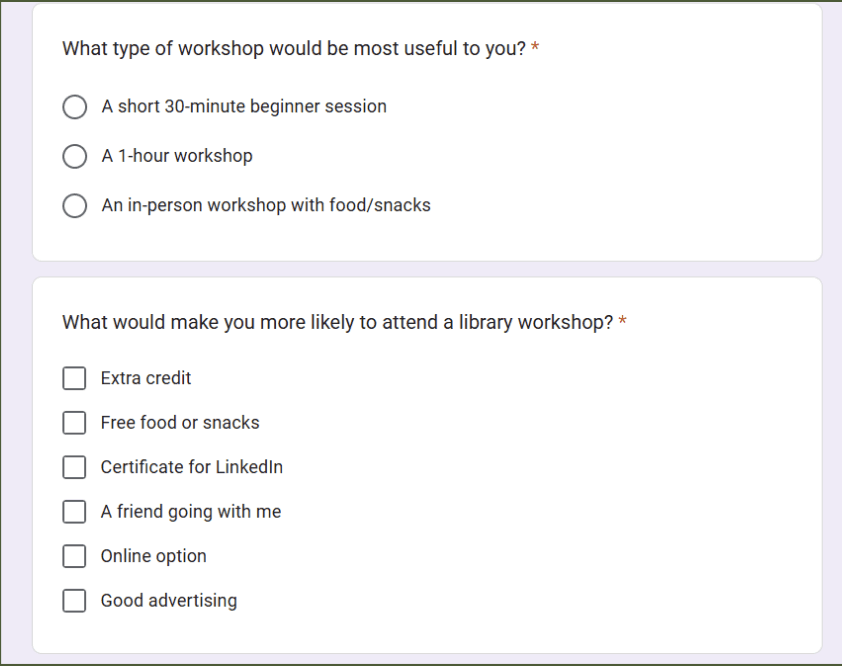
Alongside exploring new outreach strategies, our team developed a survey prototype to better understand undergraduate students' workshop interests, preferences, and barriers to participation. The goal was to help the library make future programming decisions based on direct student feedback rather than assumptions.


Bringing our findings back to the library.
We brought our research, design process, and proposed solutions together in a final presentation for the University of Miami Libraries. We shared our findings from student interviews and observations, explained how feedback shifted our thinking beyond flyers, and presented our survey prototype alongside recommendations for improving undergraduate workshop engagement.

What we delivered & what's next.
Project outcomes
Outreach and flyer concepts
Undergraduate workshop survey prototype
Stakeholder presentation and recommendations
Opportunities to explore
Collect broader student feedback
Test flyer effectiveness and discoverability
Explore faculty and campus partnerships
What this project taught me.
The most valuable part of this project was learning when to reconsider an initial solution. Student observations revealed that discoverability was part of the problem, while feedback on our flyers challenged whether visibility alone would lead to engagement. This experience reinforced the importance of questioning assumptions and exploring the systems surrounding a user experience.